
Licence advisory
S/4HANA
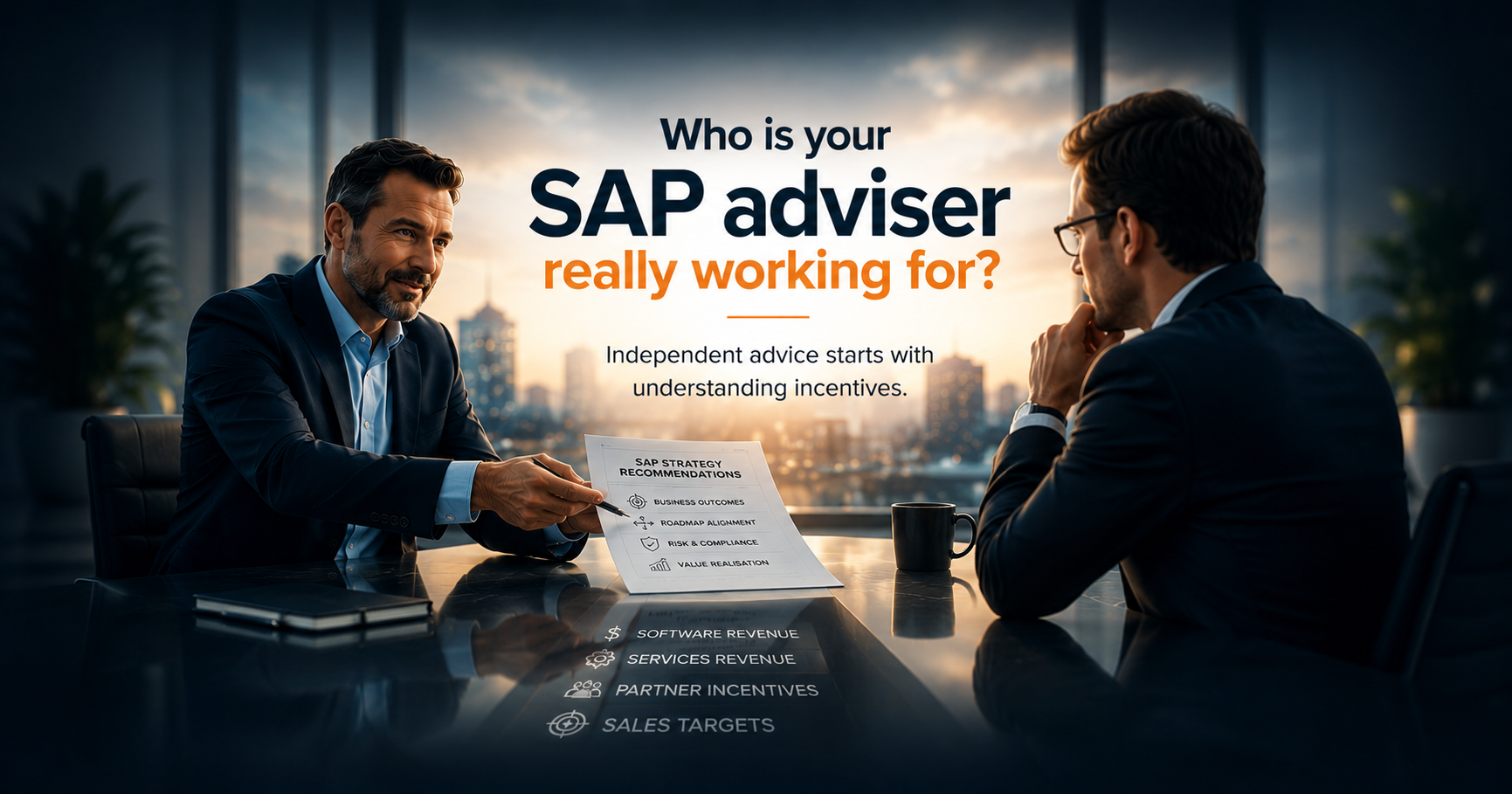

When an organisation faces a major SAP decision, the first place it usually turns for advice is the relationship it already has. That might be a Big Four consultancy, a systems integrator, or a value-added reseller. These are familiar partners, often embedded in the organisation's operations, and the assumption is that their knowledge of the business makes them the right people to guide a licensing negotiation, a procurement exercise, or an S/4HANA transition.
That assumption is understandable. It is also, in many cases, the reason the organisation ends up with an outcome that does not reflect its actual interests.
The challenge is not competence. Most Big Four firms and established systems integrators employ experienced, knowledgeable people. The challenge is structural, and it sits in the commercial model rather than in the capability of the individuals involved.
Systems integrators and SAP partners generate their primary revenue from professional services delivery. Their business model depends on winning and delivering SAP implementation work. That creates a set of incentives that are difficult to separate from the advice they provide, regardless of how well-intentioned it is.
SAP frequently engages its partners on transformation and upgrade projects, with licensing structured as part of that broader engagement. The partner wins the delivery work, SAP secures the licensing transaction, and the two are packaged together in a way that can be difficult for the customer to separate. Within that dynamic sits an unwritten but well-understood commercial reality: a partner that negotiates too aggressively on licensing terms on behalf of a customer, pushes back on contract clauses, or recommends against a particular SAP product path has to consider what happens at the next opportunity. SAP has a choice of partners to bring into the next transformation project. A partner that has made itself difficult in a previous engagement may find that the next opportunity goes elsewhere. Nobody writes this down. Nobody needs to. The commercial incentive to stay aligned with SAP's interests is self-reinforcing, and it operates in the background of every piece of advice that partner gives your organisation.
SAP's own leadership has described the broader dynamic plainly. When explaining the shift to cloud-only partner incentives, SAP's chief partner officer stated publicly that 'compensation drives behaviour.' SAP's go-to-market strategy is explicitly designed to use partners as the mechanism for landing transformation projects and then encouraging customers to expand their adoption of SAP's broader platform. Partners are incentivised at every stage of that lifecycle, from the initial engagement through to renewal, to drive consumption growth.
Partners that sell SAP software through the PartnerEdge programme receive significant financial incentives on licensing transactions. Under SAP's current model, partners earn commissions based on deal size and breadth of software for initial deals and renewals. These are not small margins on incidental sales. They are structured incentive programmes designed to align partner behaviour with SAP's commercial strategy.
SAP has shifted all business development funds, marketing development funds, and partner commissions exclusively to cloud. Partners that want to earn incentives must sell cloud. Partners that align with SAP's strategic priorities in cloud and AI receive preferential treatment in SAP's partner levelling framework, which determines their status, their access to SAP resources, and their visibility in the market.
The practical implication for customers is significant. When a VAR or partner-aligned adviser recommends a bill of materials for your SAP environment, that recommendation is shaped by an incentive structure that rewards the inclusion of newer cloud capabilities, AI credits, and expanded platform adoption. The bill of materials may be commercially optimal for SAP and financially rewarding for the partner, but whether it is the right fit for your organisation's actual requirements, budget, and adoption readiness is a different question entirely.
What makes this particularly difficult to navigate is that these incentives are sometimes offered in part or in full to the customer as commercial sweeteners: discounted licensing, migration credits, or preferential terms that look attractive on paper and help build the internal business case. The customer sees a compelling financial offer. What they may not see is that accepting it binds them to a specific software configuration, a specific deployment model, and often a specific partner for the delivery, before they have independently assessed whether any of those choices are the right ones for their organisation.
By the time an organisation has accepted partner-facilitated licensing terms, built a business case around the proposed approach, and aligned internal stakeholders to a particular direction, changing course becomes extremely difficult. The business case is built on the partner's stated position. The software configuration reflects what the incentive structure rewarded. The delivery partner may not be ideal for the complete scope of the work, but the commercial arrangements are now intertwined in a way that makes switching costly and disruptive.
For a change that happens once in a generation, this is a significant risk. The organisation has effectively committed to a path shaped by the commercial interests of the partner and the vendor before it has independently validated whether that path is the right one. Software it may not need or fully use, a partner whose capability does not perfectly align with the specific scope, and a business case built on assumptions provided by the parties with the most to gain from the decision going ahead.
This is not a scenario that unfolds through malice. SAP and its partners are experienced at navigating these processes. They are often personable, knowledgeable, and appear to be acting squarely in the customer's interest. But the customer needs to understand that these are commercial organisations navigating toward outcomes that have been shaped well before the customer entered the conversation. The processes are designed, the incentives are aligned, and the momentum builds in a direction that optimises margins for the partner and the vendor alongside whatever value the customer receives. Caution is not cynicism. It is commercially responsible behaviour for a decision of this scale.
There is a second issue that compounds the commercial one. Systems integrators build their delivery capability around specific approaches, methodologies, and resource pools. Those capabilities represent a significant investment, and they naturally shape the recommendations the firm makes.
When an SI assesses your requirements for an S/4HANA migration, their recommendation will inevitably be influenced by the skills they have available, the deployment models they are experienced in, and the commercial arrangements that work best for their delivery model. A firm with a large team of RISE with SAP consultants is more likely to recommend RISE. A firm with deep on-premise migration experience will lean toward that path.
Your organisation's specific requirements may not align with what the SI is best equipped to deliver. Your budget may suit a different deployment model. Your change capacity may require a phased approach that does not match the SI's preferred programme structure. Your long-term architecture may benefit from consolidating around SAP in some areas and diversifying in others, a recommendation an SAP partner is structurally unlikely to make.
In a market where quality SAP resources are already stretched, this misalignment has real consequences. Organisations end up in large-scale engagements with partners whose core capability does not precisely fit their needs, paying premium rates for resources that may be available more cost-effectively from specialist firms better aligned to the specific requirements of the work.
The alternative is not to exclude systems integrators from the process. They are essential to delivering SAP programmes. The alternative is to ensure that the decisions made before the SI is engaged are genuinely informed by the organisation's interests rather than shaped by the partner's commercial model.
Independent specialist advisory sits at this point in the process, before the commitments are made. The work involves understanding the organisation's real requirements: what is the available budget and is it realistic for the stated objectives? What is the organisation's genuine capacity to absorb change? Is the proposed approach fit for purpose, or is it shaped more by what suits the SI than what suits the business? Should SAP be consolidated or should certain capabilities be delivered through better-aligned alternatives?
This analysis informs everything that follows. The RFP reflects genuine requirements rather than assumptions shaped by a partner's incentive structure. The evaluation criteria are grounded in what the organisation needs. The shortlist of partners includes firms whose specific capabilities and approach align with the real requirements, not just the firms with the largest brand or the closest vendor relationship. And the licensing configuration reflects what the organisation will realistically adopt and use, not what a bill of materials optimised for partner incentives suggests it should buy.
When an organisation enters an SAP licensing or contract negotiation with an independent assessment of its position, the dynamics of that conversation shift significantly. SAP does not publish its pricing models. The commercial conversation is deliberately asymmetric, with SAP's team negotiating from a position of deep familiarity with every lever in the agreement, while the customer's team is often encountering these structures for the first time.
A partner or SI involved in that negotiation will advocate for the customer to a point, but only to the point where advocacy does not risk the next opportunity SAP might bring their way. An independent adviser has no such constraint. The hard questions about licensing terms, consumption cost trajectories, flexibility provisions, and contractual protections can be asked and pressed without any consideration other than the customer's outcome.
This is not about being adversarial with SAP. It is about ensuring that the organisation signing the agreement fully understands what it is agreeing to, what the commercial implications are as the business evolves, and where the real flexibility and risk sit in the terms. That clarity is genuinely difficult to achieve when the adviser providing it has a financial interest in the vendor relationship remaining undisturbed.
One of the most practical benefits of working with specialist independent advisers is access to precisely the right expertise for each phase of the process. Large SIs offer breadth, but that breadth often comes with a generalist approach applied to specialist problems. In areas like SAP licence compliance, audit defence, contract negotiation, and commercial impact analysis, depth of expertise consistently delivers better outcomes than breadth of coverage.
In many cases, engaging a specialist independent adviser to handle the commercial and strategic work, and then selecting the right SI for what they do best, which is delivery, produces a better result for the customer than relying on a single partner to do both. The specialist brings the depth. The SI brings the scale. And critically, the customer retains control of the commercial decisions that will shape their SAP relationship for years to come, rather than ceding that control to a partner whose interests may not fully align with theirs.
If you are approaching an SAP procurement, a licence negotiation, or a major transformation and want to make sure the advice you are receiving reflects your interests before commitments are made, that is exactly the conversation we are here to have.
Precipio works alongside your procurement and leadership team as a specialist independent resource, bringing SAP market knowledge, commercial benchmarking, and RFP frameworks that ensure you select the right partner for the right reasons.