Treating SAP GRC Like a Once-a-Year Problem
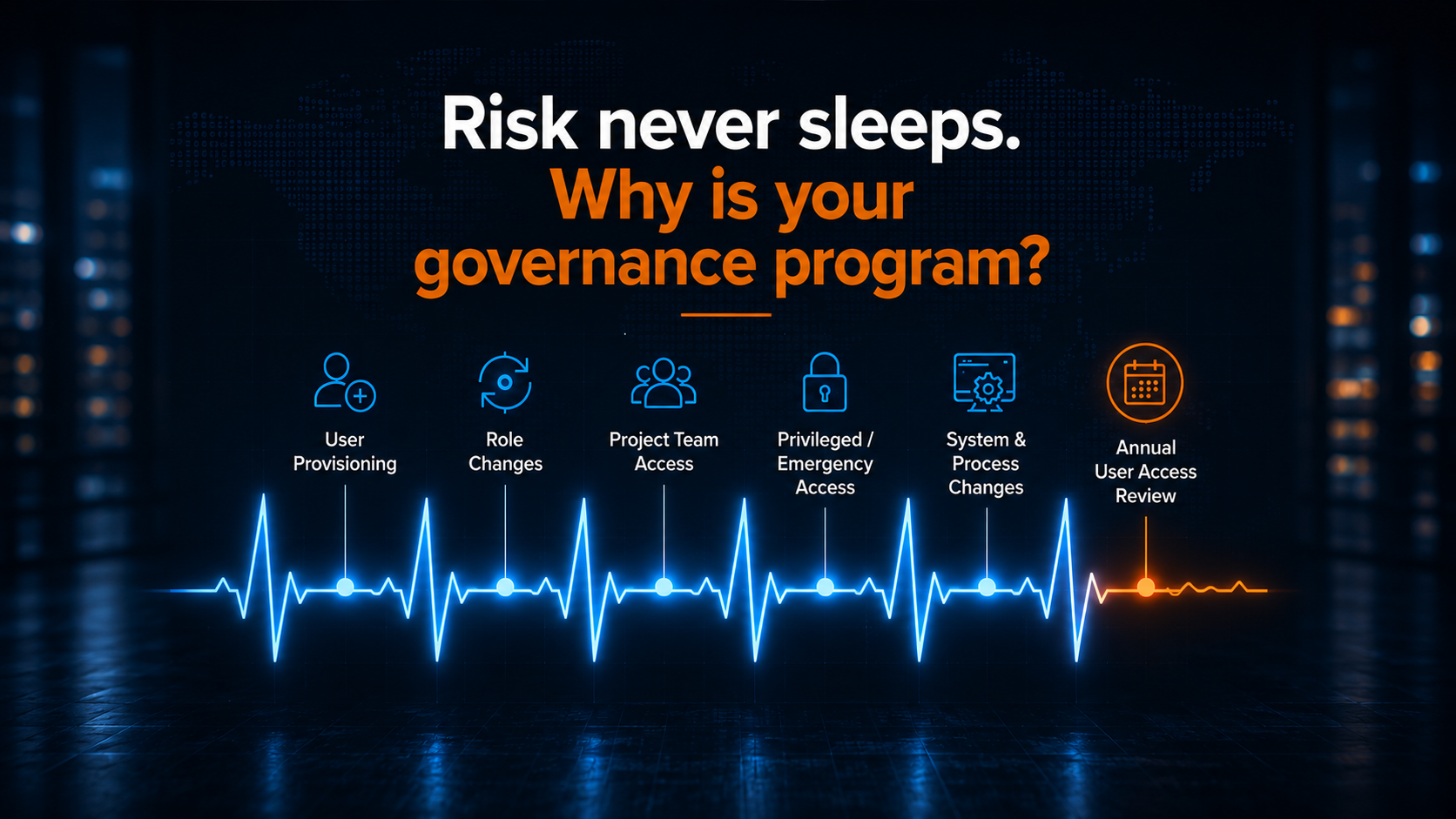
There is a pattern that shows up consistently in SAP environments, particularly in the area of access risk and compliance. An organisation invests in SAP GRC. Workflows are configured. Role owners are identified. The annual user access review is dutifully completed each year, often after weeks of spreadsheet circulation, follow-up emails, and last-minute remediation. The audit happens, findings are addressed, and then the cycle restarts, with the access landscape gradually drifting back to the position it was in twelve months earlier.
The answer is rarely a lack of effort. It is almost always the same thing: the underlying approach is built for point-in-time compliance in an environment that needs continuous compliance. Once that distinction is named, a lot of familiar frustrations begin to make sense.
The gap between owning a solution and using it
SAP GRC is a comprehensive and capable platform. It is also a complex one. For many organisations, that combination produces a quieter problem than the one usually discussed: the features exist, the licences are current, the implementation was completed, but the day-to-day use has drifted to a fraction of what it could be.
What this looks like in practice varies. Some organisations have invested heavily but use only a subset of the GRC capability they paid for, because the rest requires specialist effort to configure and maintain. Others have lost confidence in the outputs and quietly reverted to manual controls run from spreadsheets. In both cases, the value being realised is meaningfully less than the value committed to, and the solution that was meant to simplify governance has become part of the operational burden rather than the answer to it.
The resourcing picture compounds this. Maintaining a capable GRC platform requires specialist consulting, significant internal effort, and continued investment to extend into the parts of the capability that remain unused. The team is often busier sustaining the tool than benefiting from it. The distinction worth holding onto is that owning a comprehensive solution and getting value from it are not the same thing, and the right question is not which solution has the most features, but which one the organisation can actually operate to keep its access risk position current and reliable.
What 'clean once' actually costs
The annual user access review is where the cost of a periodic approach is most visible. The typical process involves extracting access data into spreadsheets, distributing them to role owners across the business, and chasing responses for weeks. Role owners already have full workloads, the process is slow, visibility is poor, and by the time it is done, everyone is relieved it is over for another year.
The challenge with this approach is not simply that it is inefficient, although it is. The deeper issue is that any cleanup achieved during the review begins to degrade the moment it is complete. People change roles. New users are provisioned. Temporary access is granted and not revoked. Contractors leave and their access lingers. Twelve months later, the same exercise begins again, and a meaningful proportion of the work involves re-cleaning what was cleaned the year before.
There is a quieter cost that is harder to quantify. When the compliance cycle is treated as a periodic crisis rather than an ongoing discipline, the organisation builds up a cultural pattern of treating GRC as an obligation rather than an operating capability. Role owners disengage. Internal audit grows sceptical. Senior management loses confidence that the controls are giving them an accurate picture of where risk actually sits.
What continuous compliance looks like in practice
The alternative is not more effort applied to the same approach, or more comprehensive capability layered on top. It is a different design, focused on what the organisation can sustain day to day. The aim is to maintain a compliant access landscape continuously, so that the annual review becomes a confirmation of an already healthy state rather than a remediation exercise.
In practice, this means three things working together. First, automated monitoring throughout the year, so that risk is visible the moment it appears rather than only at review time. Second, workflows that handle reviews, approvals, and exception management without the manual coordination overhead. Third, the ability to simulate the impact of an access change before it is made in SAP, so that role changes and provisioning decisions can be tested against the risk profile rather than discovered after the fact.

The combined effect is that compliance stops being a destination the organisation arrives at once a year and starts being a property of how the system operates day to day. The review still happens, but it changes character. Instead of starting from scratch, the organisation is confirming a position that has been maintained throughout the year.
What this changes for the audit conversation
One of the more striking aspects of organisations that have made this transition is how the audit conversation shifts. When evidence has been continuously captured rather than gathered in a last-minute scramble, when control reports are already in one place, and when access risk has been actively managed throughout the year, the auditor's job becomes easier and the organisation's preparation becomes lighter.
There are documented examples of organisations completing access reviews involving tens of thousands of role assignments and requiring only a handful of reinstatements after access removals were performed. That is not the outcome of a careful one-off clean-up. It is the outcome of an environment that has been kept current throughout the year, where the review is a confirmation rather than a correction.
For senior management, this matters beyond the audit itself. When the GRC environment is reliable, the assurance it provides to the board and to executive leadership is also reliable. The compliance function moves from being a periodic concern that absorbs attention at audit time to being a continuous capability that operates in the background.
Why this matters now
Two practical factors are bringing this question into focus for many organisations. The first is the broader shift in SAP environments toward cloud and S/4HANA. As architectures change and integration points multiply, access risk surfaces in places that did not previously exist, and the cost of carrying an unsustainable compliance approach into the new environment becomes harder to ignore.
The second is the changing workforce. Remote and distributed teams, more frequent role changes, contractors, and seasonal staff all increase the rate at which the access landscape moves. A compliance model designed for a stable, on-site workforce is no longer fit for purpose, and the gap between the rate of change and the rate of review widens over time.
For organisations whose current GRC approach is starting to feel unsustainable, the question worth asking is whether the design itself is the issue. Adding more effort to a periodic model rarely produces a different result. Moving to a continuous model often does.
Learn more about CERPASS
Precipio is a sales partner for CERPASS, a cloud-based SAP governance, risk and compliance platform built natively on the SAP Business Technology Platform. We partner with CERPASS because its approach favours realised value over unused capability, and supports a continuous compliance model that internal teams can sustain day to day. You can read more about the partnership and CERPASS's capabilities on our CERPASS partner page.