Skip to content
Licence advisory

Signing SAP Agreements with Confidence You Have Not Earned

Mark Cichowski
Mark Cichowski

There is a pattern that repeats itself across SAP environments in large organisations, and it rarely gets discussed openly. An organisation goes through a major SAP procurement or renewal. Experienced procurement professionals are involved. Legal counsel reviews the agreement. Senior leadership signs off. And yet years later the same organisation finds itself locked into commercial arrangements that do not reflect how the business actually operates, carrying compliance exposure it did not know existed, and wondering how it ended up here.

The answer is almost never bad faith. It is almost always the same thing: the agreement was signed with confidence that was not supported by the analysis needed to earn it.

The gap that most procurement processes do not close

Procurement teams in large organisations are typically skilled, experienced, and well-resourced. They know how to run a competitive process, evaluate responses, and negotiate commercial terms. What they are rarely equipped to do is perform a deep commercial impact analysis on a complex SAP agreement, not because of any deficiency on their part, but because this is a highly specialised discipline that sits at the intersection of SAP's commercial model, the organisation's future technology roadmap, and contract law.


Legal counsel faces the same challenge from a different direction. Lawyers review contracts for legal risk. They identify clauses that are unusual, obligations that are onerous, and terms that may be difficult to enforce. What they typically do not do is model the commercial implications of those clauses against the organisation's projected pattern of use over a five or ten year horizon. That is not what they are engaged to do.

The result is that the agreement gets reviewed thoroughly from two important perspectives, procurement and legal, but not from the one perspective that matters most in an SAP context: what does this actually cost us in practice as our business evolves?

What gets missed and what it costs

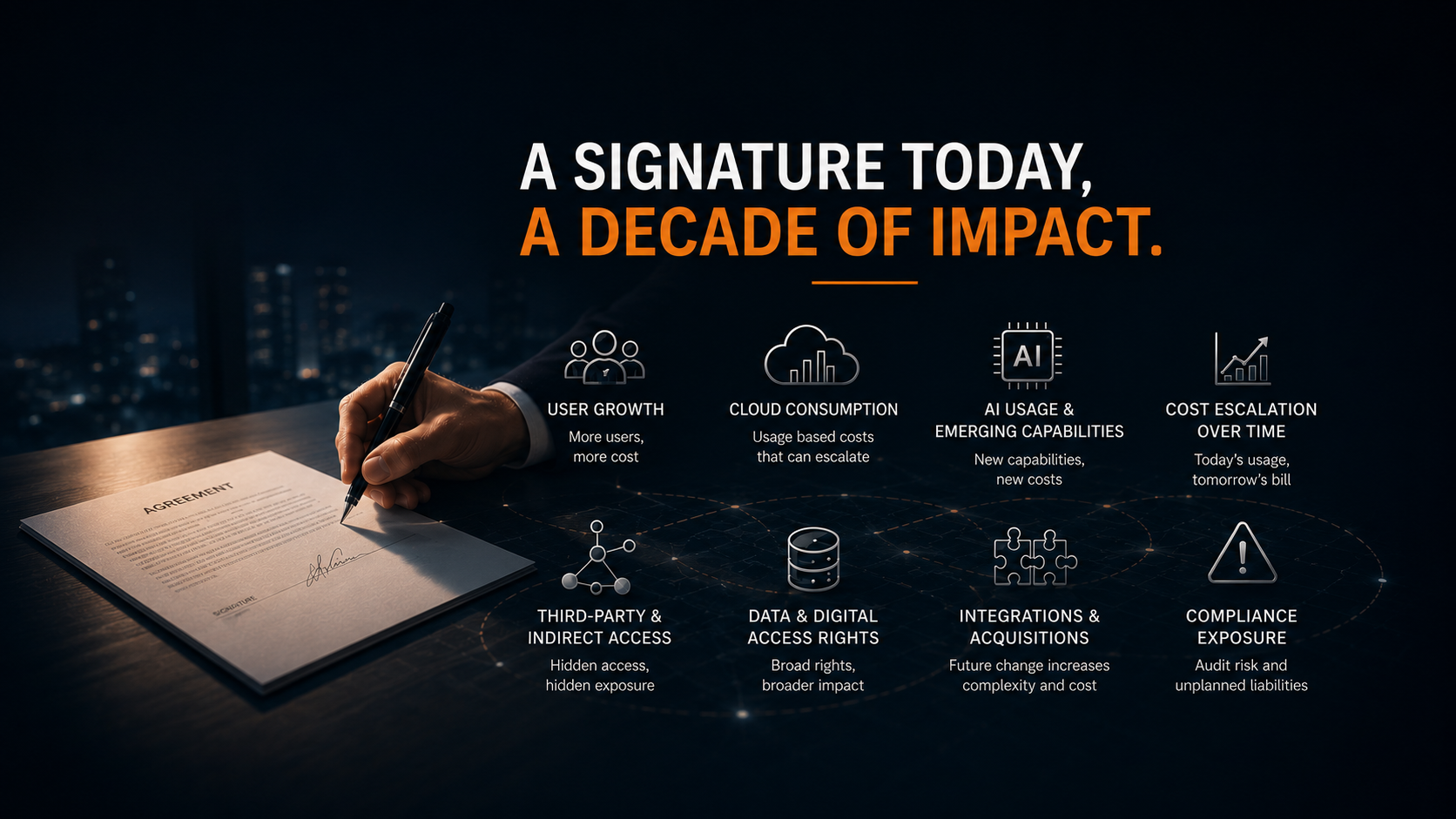
SAP agreements are not straightforward commercial contracts. They contain licence metrics, indirect access provisions, digital access clauses, and consumption-based mechanisms that interact with each other in ways that are not obvious at signing but become very obvious later.

An organisation that licenses SAP based on its current user count without modelling the implications of future growth, system integrations, or third-party access may find that what looked like a well-priced agreement at signing has become significantly more expensive as the business has changed. The terms were always there. The exposure was always there. It just was not visible until the commercial situation made it unavoidable.

This is compounded by the shift toward consumption-based commercial models. Subscription and cloud arrangements offer genuine flexibility but also introduce cost structures that can escalate materially as usage grows, particularly where emerging capabilities like AI are involved. Organisations that sign these agreements without modelling the medium and long-term cost implications are making a significant commercial commitment based on today's usage patterns applied to a pricing model designed for tomorrow's.

The dissatisfaction that many organisations feel in their SAP relationship is real, but it is rarely the result of being misled. It is the result of signing an agreement that was commercially correct at a point in time, without the analysis needed to understand how it would behave as the organisation and the technology evolved.

What the right preparation looks like

The organisations that consistently get better commercial outcomes from their SAP agreements share one characteristic: they treat the commercial impact analysis as a distinct workstream in its own right, separate from the procurement process and the legal review.

That means understanding current usage patterns and modelling how they are likely to change. It means mapping third-party integrations and digital access touchpoints against the agreement's indirect access provisions. It means stress-testing the commercial model against different growth scenarios, not just the base case. And it means understanding the flexibility, or lack of it, built into the agreement for the situations the organisation will almost certainly face over its term.

This analysis is not something that can be bolted onto the end of a procurement process. It needs to inform the negotiation, because the time to address commercial exposure is before the agreement is signed, not after.

Start before you think you need to

One of the most consistent mistakes organisations make is treating commercial impact analysis as something that happens at the end of the process, a final check before signing rather than a foundation the entire process is built on.

By the time an organisation is reviewing a draft agreement, significant decisions have already been made. The scope has been defined. The deployment model has been selected. The partner has been chosen. The negotiation is already underway. At that point commercial impact analysis can still add value, but it is working against the grain of momentum that has been building for months. Changing direction mid-process is expensive, disruptive, and politically difficult, and so compromises get made that would not have been necessary if the analysis had been done earlier.

The right time to start is at the beginning of the project, before requirements are defined, before the market is approached, and before any conversations with SAP or systems integrators have set expectations in a particular direction. Starting early means the organisation understands what it actually needs before it asks for anything. It means the RFP reflects real requirements rather than assumptions. It means the negotiation starts from a position of clarity rather than catching up to a process that is already in motion.

The practical benefit is significant. Organisations that build commercial impact analysis into the front end of their SAP journey do not just get better agreements. They get better outcomes across the entire programme, because every decision from partner selection through to deployment model is made with a clear understanding of the commercial implications rather than in spite of them. Momentum builds in the right direction from day one, and there is far less of the costly mid-course correction that characterises so many SAP programmes.

The value of working with someone who knows what to look for

The challenge for most organisations is that this kind of analysis requires a specific combination of skills that is rarely available internally: deep familiarity with SAP's commercial models, experience across a range of SAP agreements in comparable organisations, and the ability to translate complex contract terms into the commercial and operational implications that procurement and finance teams can act on.

Working with an adviser who brings that combination does not replace your procurement team or your legal counsel. It complements them by closing the gap that neither is specifically equipped to address. The result is an agreement that is commercially correct not just for today, but for the medium and long-term future of your organisation's SAP relationship.

If you are approaching an SAP renewal, a new agreement, or a major transformation and want to understand what your current or proposed agreement actually means for your organisation commercially, we would be glad to have that conversation.

Learn more about our licence advisory and negotiation service

Precipio provides independent SAP licence advisory and negotiation support, with no commercial relationships with SAP. We help organisations understand their position and engage with confidence.

SAP licence advisory and negotiation

The organisations that consistently get better commercial outcomes from their SAP agreements share one characteristic: they treat the commercial impact analysis as a distinct workstream in its own right, separate from the procurement process and the legal review.

Share this post