
Licence advisory
S/4HANA

Ask an SAP customer with a long-established perpetual estate what they would change about their agreement, and most can answer straight away. They know which licences are dormant. They know which parts of the landscape they are supporting and barely using. What they have generally been restricted from is doing anything about it, and the distance between knowing and being able to act is the most common frustration we encounter in this market.
That frustration does not stay contained to the maintenance line. It becomes the single largest constraint on doing anything further with SAP. When a material cost cannot be reduced no matter what happens in the business, every new proposal meets the same question before it is heard on its merits: what about the money we are already spending and cannot account for? We see sound initiatives stall on that question rather than on their substance. Momentum that was expensive to build leaks into caution, and the confidence to commit further drains away.
In the SAP Investment Cycle this is precisely where an organisation slides out of the honeymoon and into hesitation, and the cause is rarely the technology and often not even the price.
None of it is the result of a poor decision. It is the result of good decisions taken against the wrong scenario. When those agreements were signed, legal confirmed the contract was sound and enforceable, which it was, and procurement secured the best price available, which they usually did. Both answered their question properly. But both were assessing the Goldilocks case: the programme lands as planned, the scope holds, and the organisation in five years looks like the organisation signing today. Nobody's task at that moment was to ask what the agreement does when a programme is descoped, a product underdelivers, or the business divests a third of itself.
Two things are true at once here. SAP, like any vendor, builds its agreements to protect a recurring revenue base, which is legitimate and unremarkable. And customers, having secured a good price and a clean legal opinion, largely stopped examining the terms that would decide what happened next. In our experience the maintenance line is the least scrutinised material line in the SAP relationship, and that is not something SAP did to anyone.
On the perpetual side, that has now changed.
On 25 September 2025 the European Commission opened a formal investigation into SAP's on-premise maintenance and support practices. It identified four practices of concern. Rather than contest them, SAP offered commitments, which were market tested and then accepted. On 9 July 2026 the Commission closed case AT.40823 and made those commitments legally binding for ten years, worldwide, across every current and future on-premise customer. From opening to binding decision in under ten months is fast for a case of this kind, and it tells you SAP preferred a negotiated outcome to a contested one. There was no fine and no finding of infringement, but the Commission secured a real remedy: an independent monitoring trustee, an internal escalation route inside SAP, and penalties of up to ten percent of worldwide turnover.
The coverage since has focused on the headlines. Reinstatement fees are gone. You can split your landscape. The initial term stops restarting. All true, and all reported with little attention to what the changes were written to solve. Read without the underlying problems, they are easy to misread. One caveat before we start: the commitments cover on-premise maintenance and support only, and your cloud and subscription agreements are untouched.
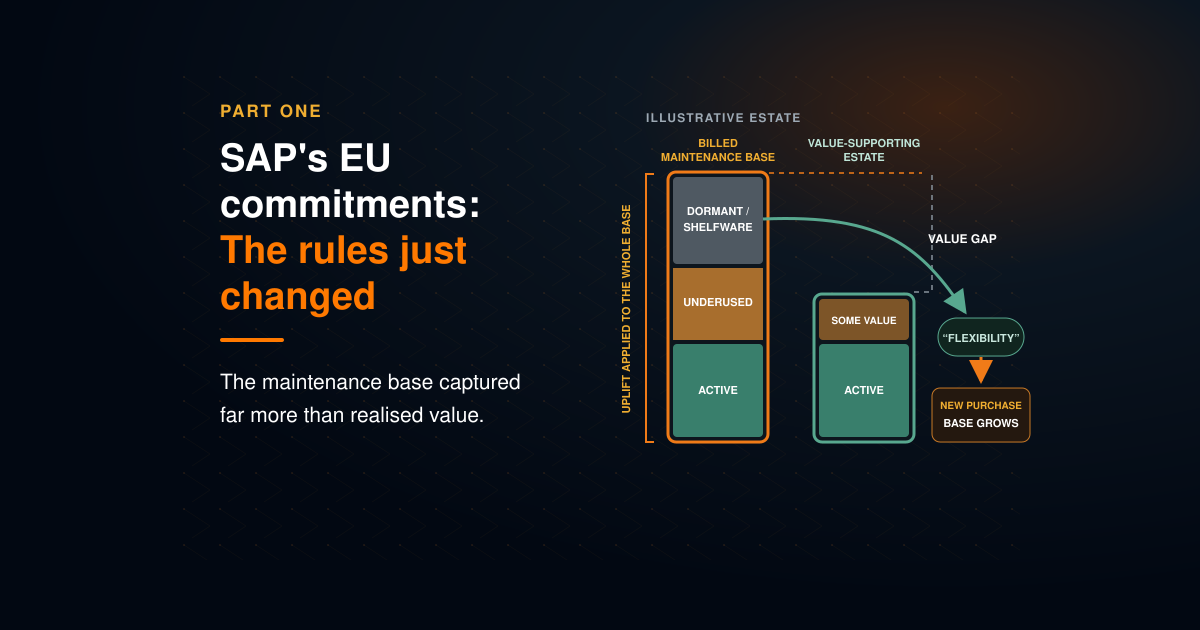
Ask most SAP customers whether they can stop paying maintenance on licences they no longer use and they will assume there is a process for it. There generally is not. The only termination right in most SAP maintenance agreements is the right to terminate the whole thing.
That matters because of how the fee is calculated. Your annual support cost is a percentage of the net licence fee you originally paid, uplifted each year. There is no measure in it of how much of the software you deployed, whether the project went live, or whether the system was switched off years ago. The fee is anchored to a purchase decision, not to a usage reality.
So consider the ordinary course of business. You bought ahead of a programme, on the reasonable logic that buying inside a large deal secures better pricing than buying piecemeal later. Then the programme loses its funding, or the product underdelivers and the capability is withdrawn. These are normal outcomes in a large change portfolio, not governance failures. But the licences stay on the agreement and the bill arrives every year, uplifted, indefinitely.
SAP does have a mechanism, and it is worth understanding because it looks like a remedy. Under its extension and exchange policies, unused licences can be exchanged out of the estate, on condition that you make a new purchase and that the resulting maintenance base is higher than before. The dormant licences come off. The recurring cost goes up. The exchange is settled by committing further spend to resolve the consequences of spend already committed.
Once money has been committed to SAP it is committed permanently, unless you leave SAP altogether, which for an organisation running finance, supply chain and payroll on the platform is not a realistic option.
That is the frustration that opened the door to the third party support market. Providers such as Rimini Street and Spinnaker will support your systems for around half of what SAP charges, often less, because they will also exclude the shelfware you have been paying SAP to maintain. The numbers are rarely the problem.
What is less well understood is the technical limit. These providers can work on the open parts of the system, the ABAP stack where they can write and apply their own fixes. They cannot maintain the kernel, and they cannot deliver updates to closed components that exist only as compiled objects shipped by SAP. That defines who the model suits: it is a strong fit for an organisation whose SAP future is finite and needs to run the estate safely while it exits, and a much harder fit for one that intends to keep investing, because the parts it cannot reach are the parts that move when you do anything ambitious.
Which brings the question that always followed, usually from a CFO or a risk committee: what happens if we need to go back? Plenty of organisations did. A security issue in a closed component, an acquisition, a regulatory change requiring a legal change package, an S/4HANA case that makes an SAP relationship necessary again.
Returning meant a reinstatement fee and back maintenance charged for the period away. In the more aggressive cases that was calculated so you had paid, in total, close to what you would have paid had you never left. Set the third party fees already spent alongside it and the position inverts: you paid twice and the business got nothing from either.
There is a second exposure that receives less attention and often ends the arrangement. Leaving SAP support does not suspend your licensing obligations. You still have to stay appropriately licensed, and if the business grows you still have to buy. In our experience the terms available to a customer who is not on SAP support look very different from the ones they were used to. An arrangement that modelled well on maintenance alone becomes untenable once the first significant purchase lands against it.
Every time you purchase perpetual software from SAP you enter an initial term. It is not the annual renewal on your invoice and it is not a notice period. It is a minimum committed period during which the termination right cannot be exercised at all. In the standard construction it runs to the end of the calendar year in which the agreement was concluded, plus the whole of the following calendar year, so a purchase in November commits you for a little over a year and one in January for almost two.
On a single transaction that is finite and defensible. The difficulty is the next one. Each further purchase extended the term again. Buy in 2024 and termination opens at the end of 2025. Buy again in 2025 and it moves to the end of 2026.
Now consider a growing organisation that tops up its user licences most years, which is the normal pattern rather than the exception. The window did not merely fail to arrive, it receded by a year every time you did business with SAP. And because the answer to "when can we terminate?" was accurately "not yet" every time it was asked, in most organisations the question stopped being asked.
SAP required support across the entire on-premise estate, from SAP, of the same type, on the same pricing conditions.
No landscape is uniform. You will have a core ERP under constant change that warrants full SAP support, and alongside it a BW estate four people log into, an SRM installation decommissioned in every sense except the invoice, and a regional ERP inherited through an acquisition and never integrated.
All or nothing removed any ability to reflect that. You could not put a specialist partner on the area where they were stronger. You could not reduce the service level on a frozen system while keeping full cover on the core. And you could not test a third party on a peripheral system before committing, because there was no partial arrangement to test with. So the choice was full SAP support for everything, or none of it including the core. Framed that way there was only ever one answer, and SAP never had to argue for it.
Each one closed the escape route from the others. You wanted to shed shelfware, but termination was all or nothing. You looked at moving part of the estate, but partial arrangements did not exist, so it had to be everything, and everything meant putting the core on a provider that cannot patch the kernel. You accepted that risk and found you could not terminate yet. You waited, and the term moved with the next purchase. And underneath it sat the return path, ensuring that if you acted and it went wrong, the correction cost more than the problem.
This is the SAP Investment Cycle at the Retain or Exit stage, and it is why that stage has, for most organisations, only ever had one available answer. You cannot exit what you cannot partially exit, cannot exit yet, and cannot afford to re-enter.
SAP waives the reinstatement fee entirely. Back maintenance is capped at the lower of two figures, calculated per commercial installation: fifty percent of the fees that would have been due across the off-support period, or six months of payments. A defined list of products attracts no back maintenance at all.
Move a stable system to a third party for three years and return, and you face six months rather than three. The paying-twice outcome is substantially removed.
Be precise about what that changes. The cost of coming back has changed. The range of customers third party support suits has not. The technical ceiling is where it was. What it genuinely unlocks is proportionality: the decision becomes something you can size, time-box and reverse at a known cost. If you looked at third party support before and walked away on risk rather than numbers, the numbers are not what changed.
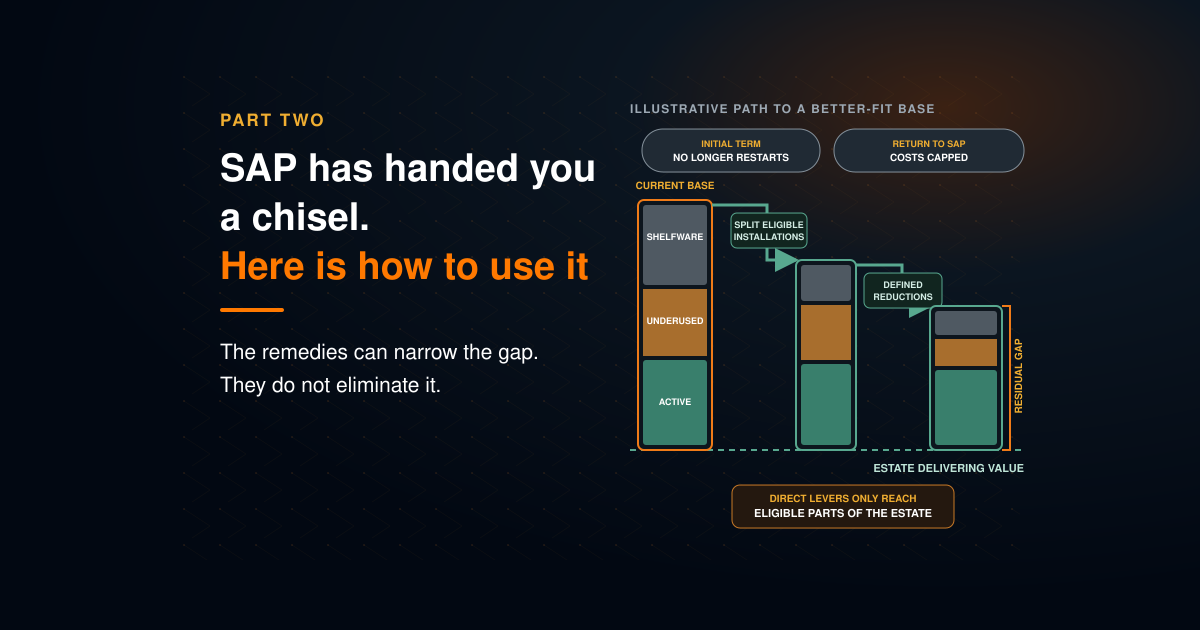
SAP has not abolished all or nothing. It has relocated it to the commercial installation. All licences inside one installation must still sit under the same support model, but different installations can now carry different models, different providers, or no support at all. Splits do not reprice licences and there is no fee to split.
So what is a commercial installation? It is a technical thing, not a functional one: SAP solutions and their licences on a technical landscape with at least one production and one corresponding non-production system, identified by its own installation number. It is the unit your Basis team would recognise, not the one your finance team would.
Picture a manufacturer with a core ERP running finance, sales, materials and production, plus a separate BW estate, a dormant SRM installation, and an ERP belonging to a subsidiary acquired in 2019 and never integrated. That is four commercial installations, and each can now take a different arrangement. What the manufacturer cannot do is anything with finance or sales on their own, because those are modules inside a single technical system. The test is not whether something is distinct functionality. It is whether it runs as its own technical system with its own installation number.
Requests are treated within six months, and a confirmed split takes effect on the next 1 January, 1 April, 1 July or 1 October following either SAP completing its processing or the end of that six month period, whichever comes first. Your initial term has no bearing on your ability to split.
SAP now confirms in writing that the initial term does not restart when you buy additional licences, and that splitting an installation does not start a fresh one.
This is the plainest commitment in the package, with nothing to apply for, and we suspect the one that will quietly matter most. Consider an organisation that concluded its support agreement in 2019, setting an initial term to the end of 2020, and has bought most years since. None of those purchases moved the date. It has been free to act for five years without knowing.
That is the ordinary profile of a growing SAP customer. So find out your date. If the standing answer inside your organisation is "we can't terminate yet", that answer was formed under a rule that no longer applies, and it may have been wrong for years.
SAP will make its partial termination policies transparent and adds defined grounds for terminating licences without re-discounting: products whose only remaining maintenance phase is customer-specific, implementation failures attributable to SAP, insolvency, and a workforce reduction of ten percent or more across two years, permitting a ten percent licence reduction retroactive to 1 January 2025. Divestitures are handled more generously, with licences transferable to the buyer or terminable outright, without re-discounting or transfer fees.
The critical thing is what sits outside. These grounds are tightly bounded, and if your situation does not fall within one, nothing has changed. A ten percent headcount reduction buys a ten percent licence reduction, not a general right to resize. A programme that was descoped or a product that underdelivered, which between them account for most of the shelfware we see, appear nowhere on the list. For everything outside, the only contractual route remains termination in full and the practical route remains negotiation.
SAP updates its policies and templates within three months, and the same principles apply to existing contracts without formally amending them. So if you are waiting to see this in your own paperwork, you will be waiting indefinitely. The rights sit outside your agreement, in a commitments decision enforceable through the Commission and monitored by an independent trustee. SAP has also committed not to achieve the same outcomes through equivalent charges by another name, and not to retaliate against customers who use the remedies.
That is unfamiliar territory for commercial teams used to rights living in the contract in front of them, and worth saying plainly to your legal and procurement colleagues before they conclude, reasonably enough, that nothing has changed.
Four locks, four answers. That is a genuine shift, and for organisations that have spent a decade unable to influence a material line of spend it is the first real opening in a long time.
It is also not a cheque. Every one of these commitments gives you an option rather than a saving, and options only pay out if you are positioned to exercise them. The tool SAP has handed you cuts coarsely, it takes longer to use than people expect, and there is at least one part of the package that can leave you worse off if you reach for it without knowing what you are doing.
That is the subject of part two: what these changes can and cannot reach, the single metric contracts SAP is now offering more widely and the trap inside them, what you would need to do now to be in a position to act, and why none of this touches the cloud agreements most organisations are signing today.
Read part two: SAP has handed you a chisel. Here is how to use it.